
General Description
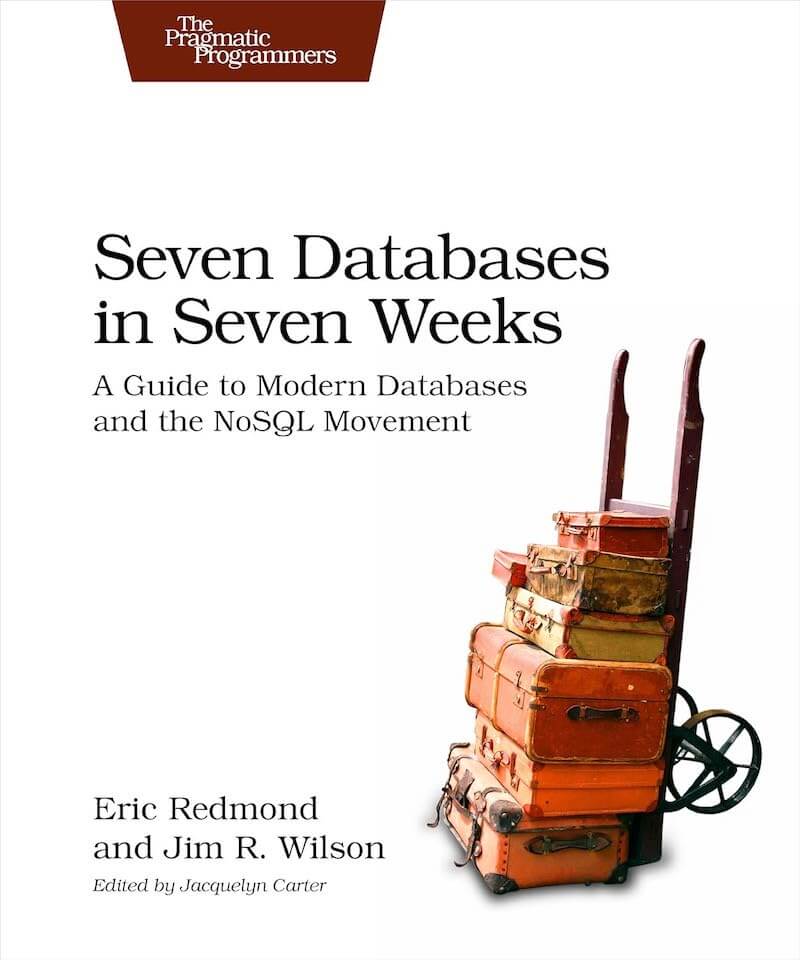
The book «Seven Databases in Seven Weeks» by Eric Redmond and Jim R. Wilson — is a practical guide to modern data storage systems aimed at developers who want to go beyond traditional relational databases. Unlike classic SQL textbooks, the book introduces the reader to various types of NoSQL solutions and shows how to choose the right database for specific tasks.
The authors structure the narrative around seven different systems, each representing a distinct approach to data storage and processing. These include the relational database PostgreSQL, key-value stores Redis and Riak, document-oriented databases MongoDB and CouchDB, the columnar database HBase, and the graph database Neo4j. This selection covers a wide range of architectures and concepts.
The book follows an intensive learning format: each database is explored over the course of a virtual «week» through practical examples. It covers basic operations (CRUD), index creation, query specifics, issues of scaling, replication, and data consistency. Special attention is paid to the differences between systems and their place within the CAP theorem, which helps understand the trade-offs involved in technology selection.
The main value of the book lies in its comparative approach. It does not delve too deeply into the details of any single database but provides a holistic understanding of how the modern world of data storage is structured and what tools are available to a developer. This makes it an excellent starting point for further study of specific technologies.
Opinion
Unlike the previous book, the title of this one speaks for itself. Of course, I did not stretch the reading out over seven weeks but finished it in about a month with a few short breaks. The book discusses seven completely different databases: one relational (Postgres), two key-value stores (Riak, Redis), one columnar database (HBase), two document-oriented (MongoDB, CouchDB), and one graph database (Neo4j). Half of them were entirely new to me, so at times the information was hard to retain, and at other times it got quite confusing.
Overall, the book is very useful and serves well for a surface-level introduction to any of these databases. For each database, it touches on topics such as syntax and commands for CRUD operations, index building (where applicable), replication, transactions (again, for those databases that support them), interfaces and methods of accessing the database, its place in the CAP theorem, and much more.