
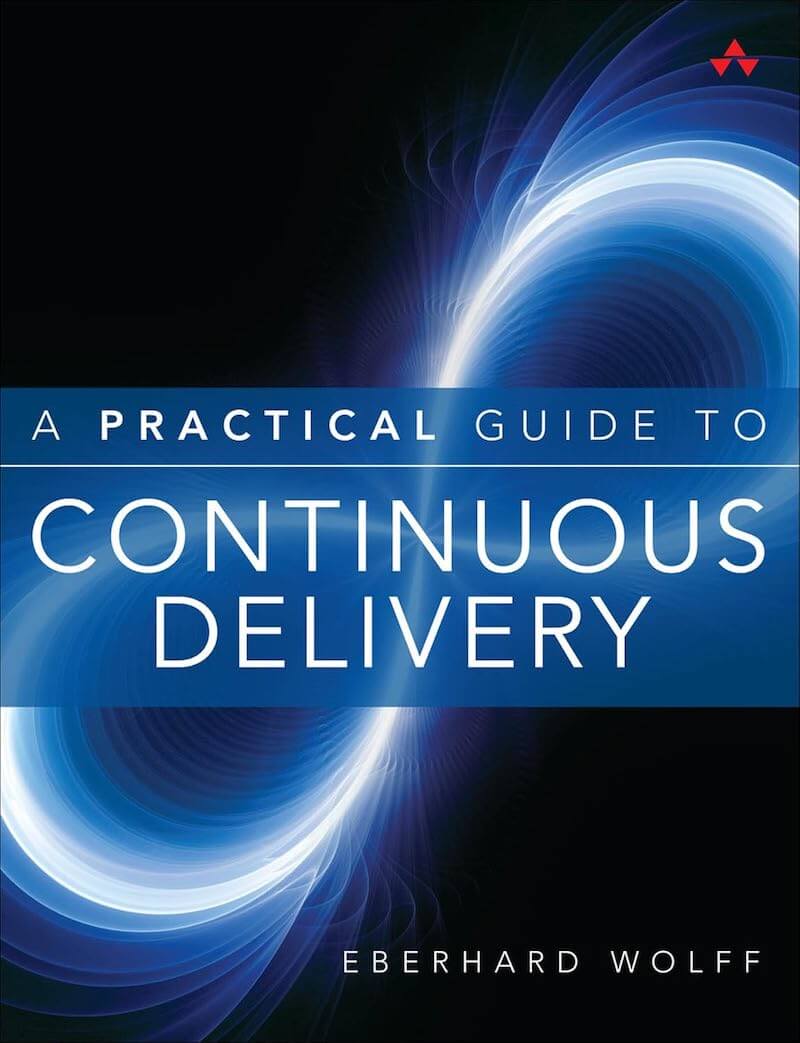
General Overview
Eberhard Wolff's book "Continuous Delivery: The Practice of Continuous Updates" focuses on establishing continuous integration and continuous deployment processes in real-world projects. This is not a motivational book or a superficial overview of trends, but rather a consistent and structured exposition of how to prepare architecture, infrastructure, and a team for frequent and safe releases.
The author views continuous delivery as a combination of technical and organizational solutions. Significant attention is given to application architecture, build automation, testing, and infrastructure management. It separately addresses issues of reliability, environment reproducibility, and risk reduction when releasing new versions.
The book details the stages of building a continuous deployment pipeline: from infrastructure preparation and build automation to testing, production deployment, and subsequent operations. Various types of tests are examined, along with their role in the pipeline and their impact on release speed and stability. It also touches upon monitoring, operations, and system support after implementing continuous delivery.
The practical value of the book lies in its numerous examples and analysis of real problems teams encounter: configuration management, working with relational databases, schema changes, migrations, tool selection, and integrating various services. Importantly, the author does not tie the discussion to a single technology stack but presents possible solution options and their limitations.
The book will be useful for developers, architects, DevOps engineers, and technical leaders who want to establish a stable and scalable process for delivering changes to their product.
Table of Contents
Part I. Foundations
- Chapter 1. Continuous Deployment: What and How?
- Chapter 2. Infrastructure Preparation
Part II. The Continuous Deployment Pipeline
- Chapter 3. Build Automation and Continuous Integration
- Chapter 4. Acceptance Tests
- Chapter 5. Capacity Testing
- Chapter 6. Exploratory Testing
- Chapter 7. Deployment – Going Live
- Chapter 8. Operations
Part III. Management, Organization, and Architecture of a Continuous Deployment Solution
- Chapter 9. Implementing the Continuous Deployment Methodology in the Enterprise
- Chapter 10. Continuous Deployment and DevOps
- Chapter 11. Continuous Deployment, DevOps, and Software Architecture
- Chapter 12. Conclusion: Key Benefits
Opinion
A decent theoretical book on how to prepare your project for continuous integration and continuous deployment. Much attention is paid to testing, as well as all sorts of potential pitfalls—from choosing a configuration management tool to changing table schemas in relational databases. Numerous services for various tasks are mentioned and described. The book's well-thought-out structure is also worth noting.