
General Description
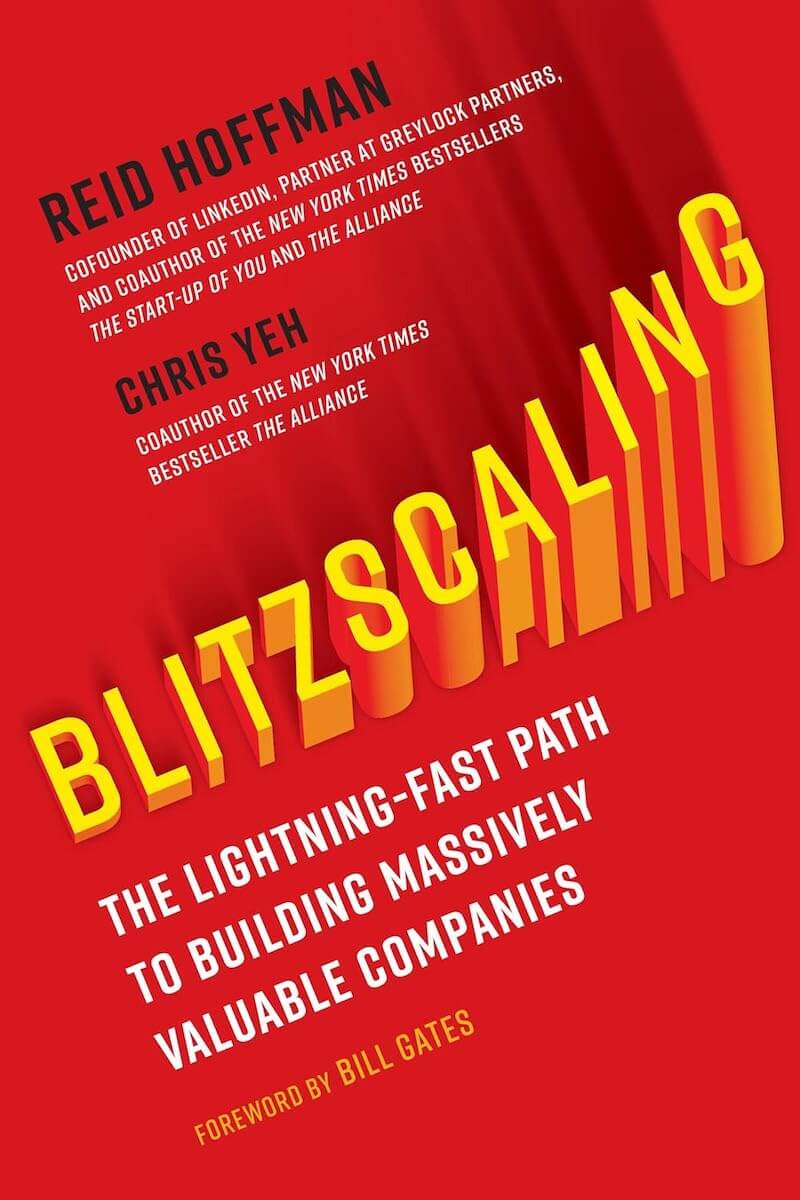
Reid Hoffman's book Blitzscaling is dedicated to one of the most aggressive and risky business growth strategies — hyper-fast scaling in conditions of high competition and uncertainty. Drawing on his own experience in creating and developing companies like LinkedIn, as well as case studies of Google, Facebook, Amazon, Airbnb, and other tech giants, the author demonstrates why at certain moments speed becomes more important than efficiency, and managed chaos becomes an acceptable price for market leadership.
The book's core idea is that blitzscaling is far from always applicable. It is a strategy for markets governed by the "winner-takes-almost-all" principle, where network effects and economies of scale are crucial, and delay can lead to the loss of the entire market. Under such conditions, companies consciously incur technical, managerial, and organizational debt, making imperfect decisions to maintain growth momentum.
Special attention is paid to the stages of a company's development. Hoffman shows that as a company grows, not only does its structure change, but so do the requirements for management, processes, and culture. Methods that work at the small-team stage become ineffective and even harmful in subsequent phases. An important theme is the evolution of the leader's role: the executive must constantly adapt, abandon familiar approaches, and learn to manage an increasingly complex system.
The book also examines in detail issues of hiring, corporate culture, and investments, emphasizing that in the context of blitzscaling, money, people, and company values become tools for maintaining speed. At the same time, the author honestly discusses the limits of the method, noting that endless fast growth is impossible, and at a certain point, a company must slow down and establish order.
Opinion
A decent book about business growth and building startups. On the plus side — it provides a detailed, real-world example-based description of an interesting method for rapid company growth. On the minus side — this method is quite risky and won't suit everyone. Furthermore, towards the end of the book, one can feel a sense of fatigue with the topic and repetition of the same ideas. For general development, especially if you have already read many other books about startups and business, this book can still be recommended for familiarization.