In my childhood and teenage years, the lotteries "Vashe Loto" and "Super Loto" were very popular. I don't know what fate these lotteries have now; perhaps one of them still exists today. However, during my childhood, my parents occasionally bought tickets and played. They were often irritated that the winnings were mostly concentrated in Minsk or the Minsk region. Because of this, whenever I was in Minsk, I was tasked with buying a lottery ticket or even several tickets at once. As a teenager, I didn't pay much attention to how absurd this request was. Recently, I learned that I am not the only one who bought a lottery ticket in Minsk and brought it home. There may be many more people like me. But now, after more than a decade, let's try to analyze the situation.
In fact, everything is quite simple. There are no winning lotteries specialized for specific regions. Although I understood this a long time ago, there are surely still those who believe in such conspiracy theories, thinking that the lotteries in Minsk and the surrounding area are luckier. It is true that Minsk lotteries have won more times, but this is solely related to the theory of probability, not conspiracy theories. Belarus has a population of about 9.5 million people. About ten years ago, the population was slightly higher, so for convenience, I will round it to 10 million. Next, let's take a look at the distribution of the population among the regions of our country. Unfortunately, I couldn't find (and didn't particularly search for) data from 2010 or 2015. However, I quickly found an article on the "Myfin" website about the population as of January 1, 2023. The specific numbers are not important to us since the percentages are based on 9.2 million rather than 10 million, but there haven't been any significant changes in these percentages over the past decade. So, here's what the statistics say about the distribution of the population within the country.
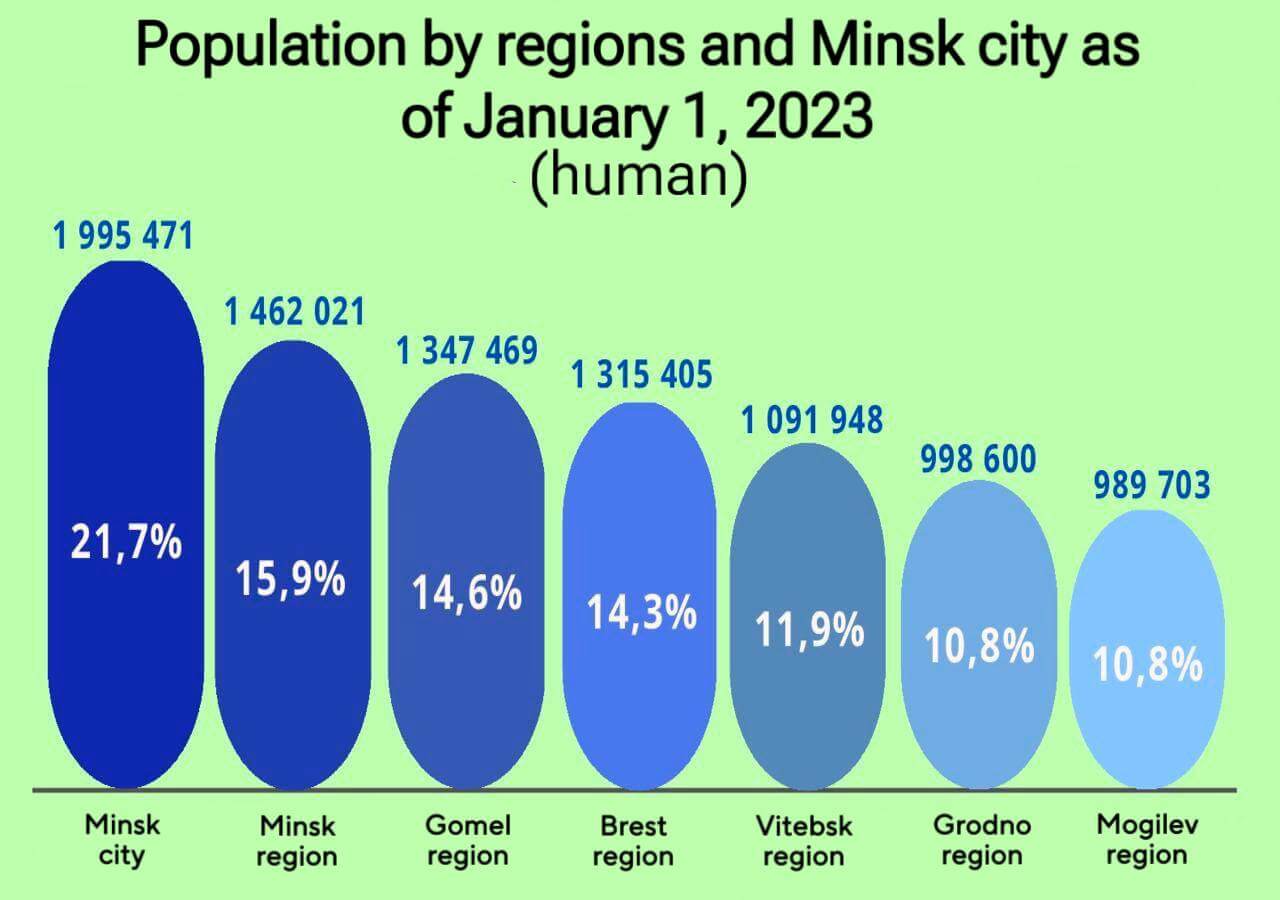
Image source: myfin.by
If we combine Minsk and the Minsk region (in sources, lottery winnings for Minsk and the region have always been reported as a single area, but for more detailed statistics, "Myfin" has separated them), we get the following distribution:
Minsk Region: 37.6%
Gomel Region: 14.6%
Brest Region: 14.3%
Vitebsk Region: 11.9%
Grodno Region: 10.8%
Mogilev Region: 10.8%
Now, let's take a look at the chart based on the data above.
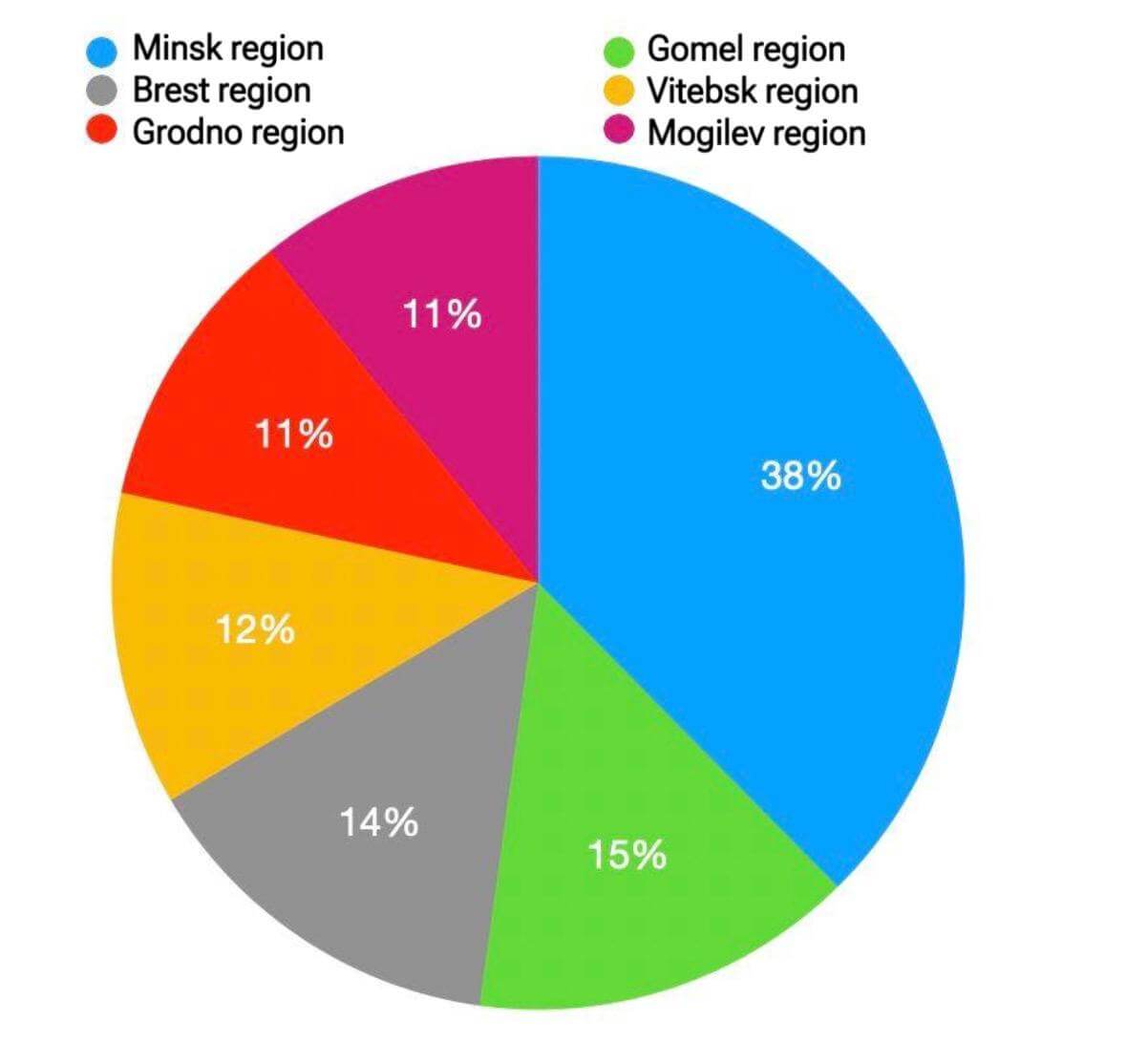
As we can see, the Minsk region combined with Minsk occupies a significant portion. This is not surprising, as together they account for just over one-third of the total.
Moving on, based on this and assuming that people across the country are roughly equally inclined to gamble, we can conclude that a significantly larger number of lottery tickets are purchased in Minsk and the surrounding region, since there are considerably more people living there than in any other region. In other words, on average, three times more people reside in Minsk and the Minsk region, which means that approximately three times more lottery tickets from the Minsk branches are bought. And if more tickets are purchased, then, all else being equal, they will also win significantly more often. That's all there is to it. No conspiracy theories, just pure mathematics and probability theory.
In case someone still doesn't quite understand, you can conduct an experiment. Take 100 pieces of paper (since we have 100 percent as the total number of lotteries). Write "Minsk" on 38 of them, "Gomel" on 15, "Brest" on 13, "Vitebsk" on 12, "Grodno" on 11, and "Mogilev" on another 11. Mix them thoroughly and randomly draw about 10-15 pieces. The overwhelming majority will be papers marked "Minsk," because there were originally more of them. The theory of probability will work for both small sizes, like 100 pieces of paper, and larger sizes, such as 100,000 lottery tickets, the majority of which were purchased in Minsk and the surrounding region, as this is where most of our population is concentrated.