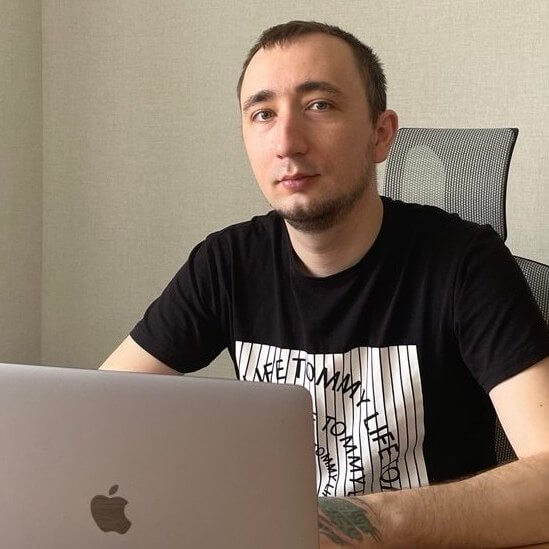
Not long ago, we had an active trip to Azerbaijan. We stayed in Baku for a few days, after which we rented a car and traveled across the country. I will try to share what came of it and what impressions we had below.
Reference Information
Before we begin, let’s take a moment to look at some reference information about Baku and Azerbaijan as a whole.
Area of Azerbaijan: 86,600 km²
Area of Baku: 2,140 km²
Population of Azerbaijan (as of 2022): 10.14 million people
Population of Baku (as of 2016): 2.236 million people
Major cities (population in thousands):
Baku: 2,225.8
Ganja: 330.1
Sumgayit: 300.3
Mingachevir: 102.4
Khirdalan: 97.2
Shirvan: 79.1
Nakhchivan (Nakhichevan): 78.1
Sheki: 64.8
Baku
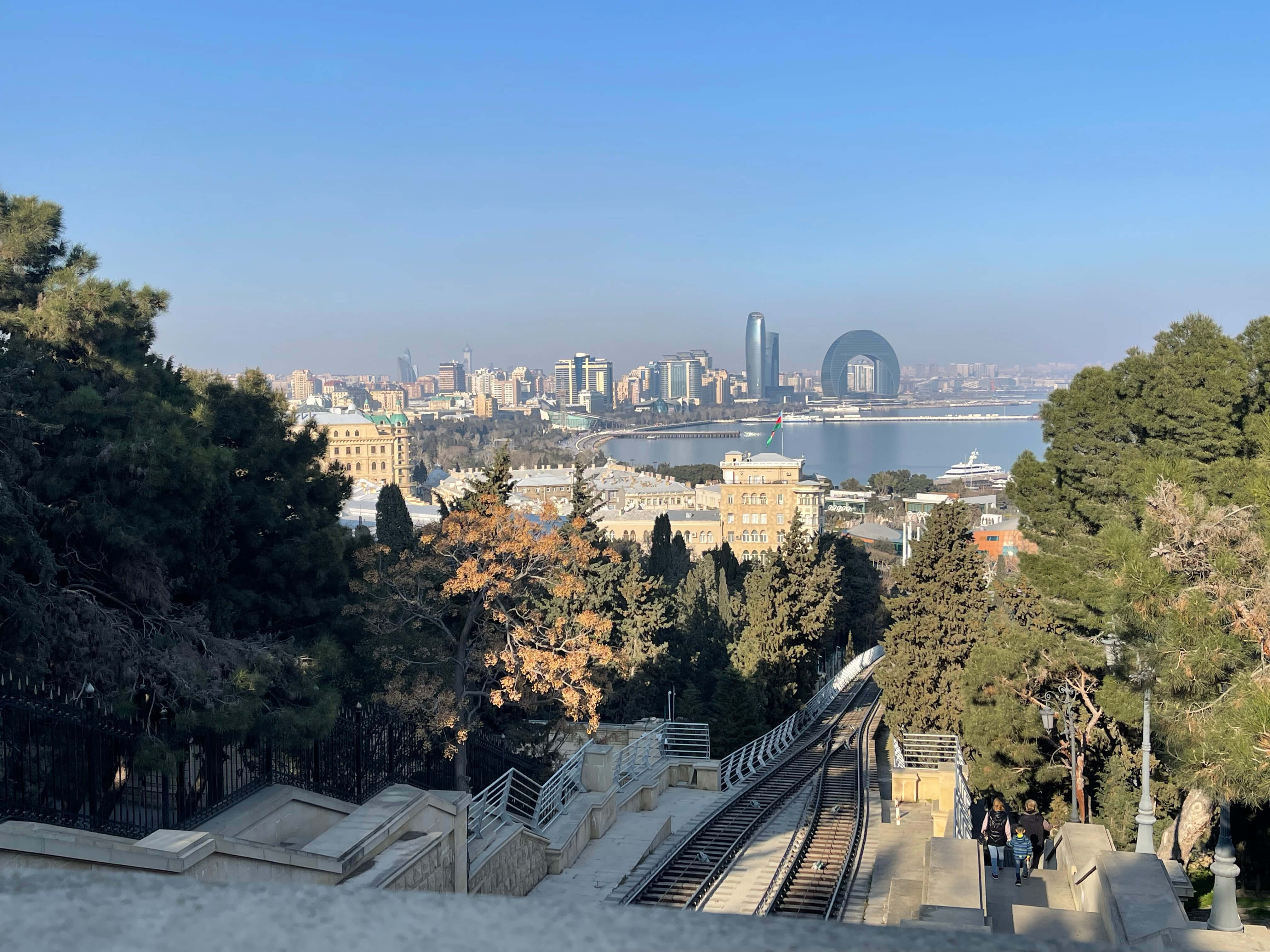
Baku, like the rest of Azerbaijan, turned out to be quite hospitable. Right from the airport, we were met by the owner of the apartment. In many countries where people rent out apartments and are fully engaged in the tourism business, it is common to offer airport transfer services. We were not only greeted but also given a small tour of the city at night. According to the reported area, Baku turned out to be ten times larger than Minsk. Most likely, the national airport and possibly other border territories were included in that figure, but nonetheless, the city indeed turned out to be quite large. It was also very clean, but quite noisy. Overall, the city left a good and pleasant impression.
Other Cities
During our time in the country, we managed to visit quite a few cities. In some places, we were just passing through, while in others we made proper stops, and in a few, we even stayed overnight.
Driving
We rented a car for five days around the third day after arriving in Baku. However, it became clear from the very first day that driving in Baku and the country as a whole would be a serious challenge for me. I had never encountered such strange driving behavior in my life. The capital has a population of over two million people, which means there were not just many cars, but a lot of them. Major traffic jams occurred even during the day. However, the sheer number of cars is nothing compared to the driving habits of the locals. In most cases, they do not use turn signals. It is quite normal for them to enter an intersection at the very last moment during the green light and simply block the intersection during all subsequent phases of the traffic light. This creates a situation where one direction is always stopped while the other consistently blocks the intersection; the situation is resolved only when the police arrive and clearly direct traffic for those who refuse to unblock the passage. Another difficulty with driving there is that they do not stick to lanes at all. It is quite common for them to partially encroach on the adjacent lane by 10-20 percent of their vehicle's body, so you always have to be alert to maintain a safe distance from a potential collision if another car encroaches into your lane. In principle, in Baku, it is customary to fill any available road space, meaning that if there is a wide lane that can accommodate two narrow cars, there will indeed be two cars driving there. The situation becomes even more dangerous when a road with a certain number of lanes suddenly transitions to a road with fewer lanes, for example, from four lanes to three. Chaos ensues, as there is hardly any proper lane marking, and everyone drives as they please for about 200 meters from the point of merging. And, of course, such traffic conditions inevitably lead to cars cutting each other off. During our time driving in Baku, some of the most notable cars that cut us off included a police car and a KamAZ truck; in turn, we also had to cut sharply into a lane in front of a Toyota Land Cruiser. It goes without saying that pedestrians are not given the right of way at crosswalks. I think it's unnecessary to mention that you not only need to be vigilant but also pray before crossing the street. Additionally, the honking is incredibly loud and frequent. Even unnecessarily: a car standing in the tenth row at a traffic light will start honking just two seconds in if the first cars do not move immediately on green.
In other cities, there are significantly fewer cars, and driving is generally easier, although this is not the case everywhere. For example, in one of Azerbaijan's largest cities, Mingachevir, which has only two major central streets, there are no pedestrian traffic lights. In fact, there are hardly any crosswalks, so people cross the road in various places. From the outside, it may seem like they have no instinct for self-preservation, but during our time in the city, we saw dozens of people crossing the road in unauthorized places, and nothing happened to anyone.
Additionally, both in the capital and in the country as a whole, there are many traffic cameras. They record speed violations and violations of crossing solid lines. By the way, we violated the latter once, for which we received a fine that came to our car, and we paid it when we returned the vehicle.
Also, there is no concept of 95 octane gasoline there; it is commonly referred to as premium. And don’t think you will find food or the option to grab a snack or buy coffee at gas stations. Even at large, civilized gas stations with signs saying “Café,” these places are more likely to be mini-cafeterias for the staff's lunch, which can sometimes be quite busy.
Lastly, it’s worth noting that almost all parking in Baku is paid. To pay, you need to download the AzParking app, which is quite easy to use. For navigation in the country, it is common to use Waze.
Police
With such a crazy driving style and a large number of cars, the police are never out of work. They are practically present on the roads 24/7, helping with traffic management. We were in the city on the first and last days of having the car, and on those days, the police did not stop us. However, they did stop us once a day on the second, third, and fourth days of driving outside the capital. There were no issues with being stopped. The police were quite polite, and after checking our documents, there were no problems at all.
Hotels
In Baku, there is a huge selection of hotels and apartments where you can stay. This cannot be said about other cities, such as Ganja or Mingachevir. There are not many options for booking on Booking.com. However, while passing through various cities, we encountered hotels that were probably not listed on Booking, so it’s hard to say whether they are good or not and whether tourists can actually stay there.
Besides the apartment in Baku, we had a motel in Mingachevir. Surprisingly, it turned out to be quite a nice motel. It was located right at a gas station, but this was more of an advantage than a disadvantage. The rooms inside were also quite well-kept and tidy.
Landscape and Terrain
Azerbaijan is a country that combines both mountainous terrain (mainly in the north) and flat landscapes (mostly in the center). Both the flat and mountainous areas are characterized by slight aridity and a lack of greenery.
The country evidently has a lot of natural resources in the form of yellow stone or sand, from which almost all private houses in the country are made, designed as large yellow bricks.
Russian Language
Since this is a post-Soviet country, there were no major issues with the Russian language. Like in all post-Soviet countries, young people tend to know less Russian, but the adult population generally communicates in it. So, in almost any establishment—from stores to gas stations—you can almost always find an employee who understands Russian. English is known significantly less across the country compared to Russian, so it’s better to use Russian as the language of communication, although in Baku, you can confidently use English as well.
Roads
From the first day of our stay in the country, we were assured that the roads in Azerbaijan are very good. However, on the very first day of renting the car, we got the vehicle very dirty and dusty. This was due to the mountain repair roads. For about 20-30 kilometers toward the city of Sheki, we drove very slowly on a dusty road. Other than that, the roads are indeed good. There are few cars between cities. The roads are often two-lane in each direction. Typically, there are no potholes on such roads, and the speed limit is allowed up to 110 km/h.
Air Temperature
Our trip was at the very beginning of April, so we experienced relatively warm weather. However, the sea breeze made itself felt, and the warmth was always accompanied by wind.
Population
Upon leaving Baku, the change in scenery is quite noticeable. First, the crystal-clear city gives way to the outskirts, where there is litter. And there is quite a bit of trash, mainly along the roads, in potholes, and in ravines. Second, expensive cars are replaced by Ladas. Outside of Baku, the old Soviet Lada is the most common car. Despite being old, these cars are generally in good condition, and very few show signs of rust. This is likely due to the milder winters, which are not as cold and snowy, meaning there is no need to spread a lot of salt on the roads in winter. From these points, one can draw the obvious conclusion that life in Baku and outside of Baku resembles life in two different worlds: the class difference between residents is quite pronounced, which is not the case in Belarus, for example.
Mingachevir
Since we stayed in this city for three nights in addition to Baku and explored it and its surroundings quite well, I can describe it a little. In the "Driving" section above, I already mentioned that there are almost no pedestrian crossings or traffic lights for pedestrians, but this city has many other features, some of which are quite pleasant. Firstly, compared to other populated areas (excluding Baku), there are many cafes here, and there are even restaurants. While men sit and play backgammon in cafes on the outskirts of the city, there are more young people in the center. There is also a nice, beautiful waterfront in the center, which looks lovely even at night, although it is a bit dark. Additionally, along the entire Heydar Aliyev Avenue (which is at least 5 km long on one side of the city), there is a pleasant promenade for walking. By the way, there are many places named after Heydar Aliyev in Azerbaijan, so you will encounter the name of the former president quite often. Also, in the surrounding areas of Mingachevir, as in many other towns, perhaps except for Baku, you can find many portraits of military figures. They are usually located along the roads.
Attractions
It goes without saying that Baku has many attractions. To visit them all at a reasonable pace would take 2-3 days. We saw a lot: from the waterfront and the old city, which are located in the city center, to the Pink Lake and the Round Castle, which are far from the center. First and foremost, I would recommend exploring the attractions in the center.
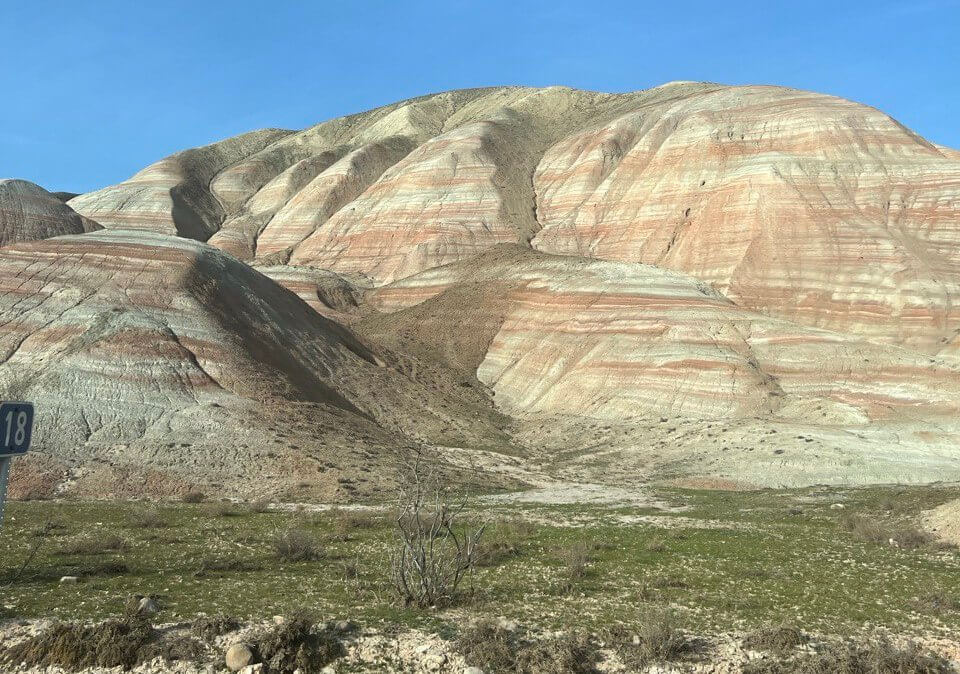
Next, we headed north to see the Colored Mountains and Mount Beshbarmak. These are also quite good candidates for attractions worth visiting if you have the opportunity.
On the way west, if you veer north, you'll find the wonderful city of Sheki, which has very pleasant attractions. The main streets of the city are paved with cobblestones, the buildings are in good condition and of original style, and the city is situated on a hill, so the narrow streets beautifully wind around. The city is definitely tourist-friendly, so I recommend visiting it.
As I mentioned earlier, the area and terrain are predominantly dry, but if you find yourself missing a typical Russian village during your walk, you can stop by Ivanovka. It closely resembles the villages we are used to. Additionally, there are many green flat fields surrounding it.
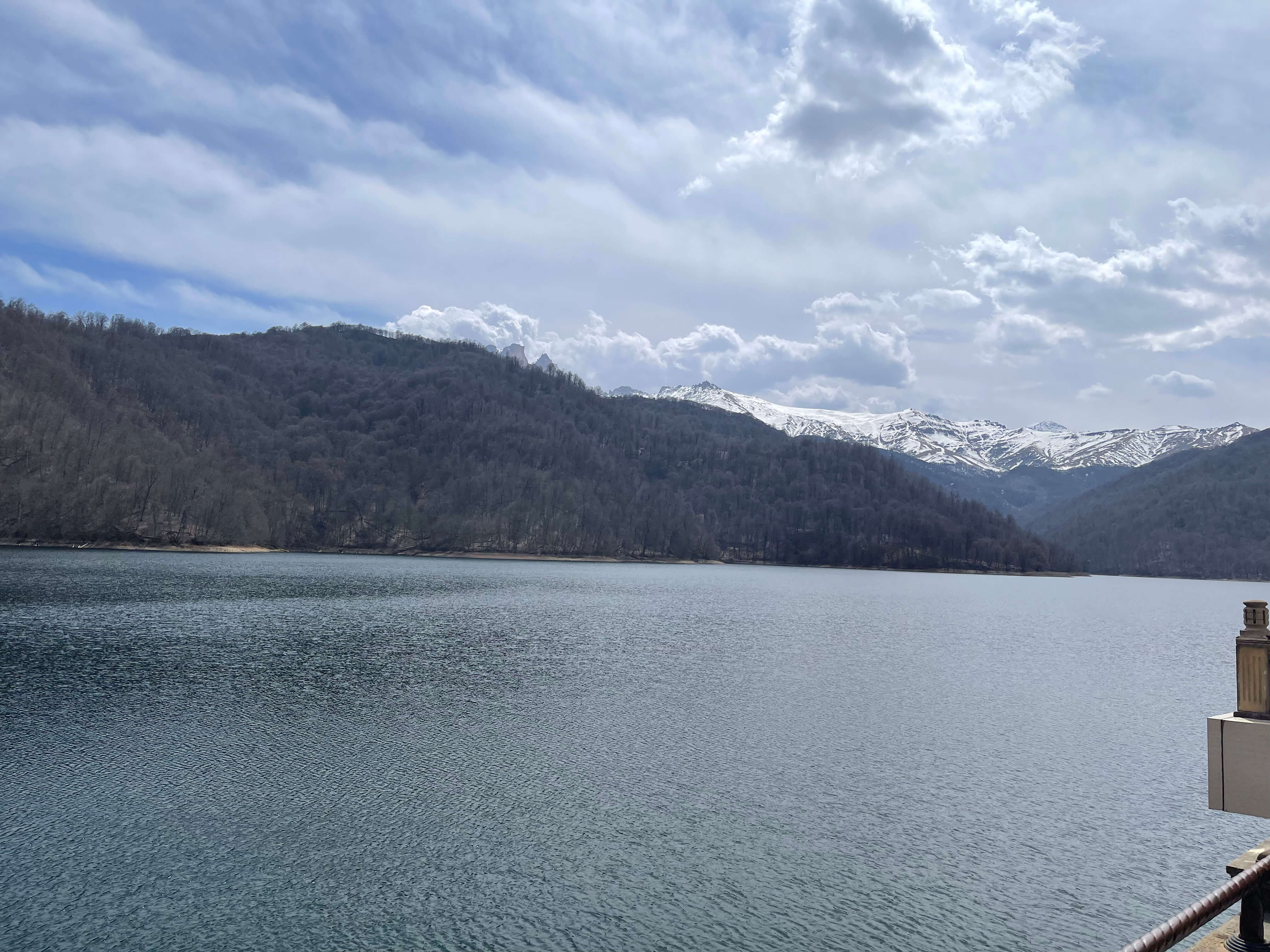
I also highly recommend visiting the mountain lake Goygol.
The advertised attraction of "Naftalan, the health resort city," did not quite meet expectations and turned out to be not the most beautiful or picturesque place, especially considering the amount of litter in the surrounding areas.
Underpasses
It is also worth mentioning the underground crossings in Baku as a unique form of art. I have never encountered street underpasses with escalators, paintings, and sculptures inside in any other country.
Prices
At the end of the article, I would like to discuss prices in Azerbaijan. Of course, everything is quite relative, and it’s not accurate to simply say that prices are high or low. I will try to compare them with prices in Minsk and Belarus. Fuel is definitely expensive there, so if you plan to rent a car, it's better to choose one that is economical in fuel consumption. By the way, there is a good selection of cars, and we drove a brand-new vehicle straight from the dealership. Baku itself is also not the cheapest city, and prices are generally 1.5 to 2 times higher than in Minsk. The second most expensive city after Baku is Sheki, which can be considered quite touristy. Prices there, while lower than in Baku, are still relatively high for a small city. In other places, excluding the capital and Sheki, where we made purchases—primarily in Mingachevir—prices were low and even below those in Minsk. Moreover, in one of the restaurants in Mingachevir, we found the food to be very cheap and delicious, so we visited it several times.
More real photos and videos of Azerbaijan can be seen on my Instagram account: shitik.sasha